
The Spirit of Christmas Past

A Christian hath no solstice … where he may stand still, and go no further.” —John Donne

That season is upon us and it’s time to wonder once again whatever happened to the spirit of Christmas.

Of late, political/religious correctness has added its voice to the consumer Babel and is deadening the religious message still further, so let’s refresh our take on this most popular and stressful holiday of the year.
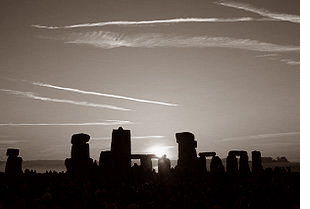
Stonehenge on the winter solstice

In pagan days, this time was called Yule, and celebrated the winter solstice (sun standing still, or the turning point in its journey away from Earth). The early Christians didn’t simply replace the old holiday with the new – they adapted the notion of turning point to carry their own message.

The birthday of baby Jesus became a pivot between the fasting period of Advent (the coming) and the 12 days of Christmas, when friends and family made gifts for one other. They conclude with the Epiphany, when the new is fully manifest and we return to daily life with renewed spirit.

Clearly, this is meant to be a time of reflection. In fact, Advent was set aside for prayer, fasting and penitence.

We don’t see much of that these days. We’re busier than ever – not just with cards and gifts, but also with food and household shopping.

Most wonderful time of  the year?

Business too must be wound up for the break. There are office parties to attend, damaged relationships to repair and prodigious quantities of food and drink to consume. We’re expected to shop until Christmas Eve, take a 24-hour break, and then go right back to shop in an even greater Boxing Day frenzy.

These are only some of the pressures. Guilt is another, for it’s squirmfully obvious that even though few of us consider ourselves rich, we’re more wealthy and wasteful than most human beings will ever imagine – not that it makes us happier.

For many, Christmas time magnifies loneliness and isolation beyond all reason. This is the busiest time of year for mental health workers.

Theoretically, our involvement is a matter of choice. On the other hand our society, which specializes in delivering high-speed, if not instant, gratification, also specializes in telling us what we want – why bother with the miseries of fasting when we can get straight to the good stuff?

How do we go against the flow? Should we seal ourselves off from the mêlée and contemplate our sins until the 25th?

New year, new resolution

Slowing down to take a deep breath right now sounds like an act of radical, almost impossible sanity – but as we’ll be reminded once again in the New Year, making resolutions is one thing, keeping them is another.

Anyone who meditates or tries in any way to live a contemplative life is faced with this stubborn problem. To succeed, our resolution must be understood as a turning point and not an end in itself.

Change is a process in which the same decision is made again and again – not just when we feel like it but every time the old habit reasserts itself.

Whether you want to quit smoking, practice mindfulness or resist the holiday madness, you have to know and accept your present circumstances, set a realistic goal and understand that getting from here to there is a journey of many steps.

It would be great if we could set aside this time of year for quiet and mindful reflection, peace and good will, but all we ever do is lament the fact that no one does it.

Keep the spirit: Mindful reflection will outgrow compulsion

The beauty of the meditative life – and also its great difficulty – is that it’s all a matter of attitude. We don’t have to follow the crowd, but neither do we have to stick out like a sore thumb.

To cultivate a healthy Christmas spirit, reflect that we’re counting down to the shortest day, and that even though the coldest months are yet to come, the light is on the upswing.

You might take a moment to breathe, only to find yourself on your feet again, driven by the tide of That Which Must Be Done.

Don’t be disheartened. Especially, don’t resort to blaming anyone – whether it’s yourself, modern times or global consumerism.

Just keep making your resolution, no matter how many battles you lose. Grab each moment of sanity in the knowledge that you’ll lose it again. Keep up this spirit and sooner or later the tide will turn.

With determination and patience, mindful reflection does outgrow compulsion.

And while you’re doing all that, there’s absolutely no reason why you can’t enjoy a Merry Christmas and a Happy New Year.


A version of this post originally appeared in a 2006 issue of The Montreal Gazette.

Post-9/11: Fight the Terror with Compassion

Ten years have passed, and in millions of small ways, Al Qaeda’s 9/11 attack has undermined our sense of security and our stability. It’s successfully nurtured disarray in our institutions and dissent in our ranks. The West’s response — flouting the Geneva Convention, special renditions and torture — speaks to the desperation of our leaders. Anti-Muslim sentiment reflects it on the streets.

We had to do something about it, but that doesn’t justify desperation. The horror of what the terrorists did doesn’t mean we must fill our hearts with hate. That’s what they want. We rejoice when one is killed, but if they’re happy to die, where’s the sweet revenge — and who ever benefitted from revenge anyway? Osama bin Laden is dead, but each time we compromise our values, he wins another battle.

At the outset of a more conventional war, Winston Churchill announced bluntly, “We shall never surrender.” He wasn’t speaking only of military strategy, but about the optimism and humor of the British in the face of overwhelming odds, about their willingness to sacrifice and their stiff upper lip. Our odds seem overwhelming too, though in a different way. The enemy is invisible; it’s ruthless; there’s no front line. Still, like the Battle of Britain, it’s also a battle of hearts.

We thought at first these terrorist were crazy evil people, but it turns out that many of them were educated family men and women. It was confusing, but also an opportunity to look behind the stereotypes and propaganda, to break down the us-them mentality. The horror of what they did a decade ago cannot be justified, but that doesn’t mean it can’t be understood. We call them inhuman, but only humans do this. What made these people, who loved and were loved, sacrifice their lives in order to kill thousands of innocent people and terrorize a generation? To walk away from this question is not just irresponsible, it’s cowardly.

Some among us are outraged at the thought that we should view the enemy as anything but monsters — that it amounts to desecrating the memory of those who died. This knee-jerk response has only one outcome: to prolong the hatred. How does that honor the dead?

Wars end when enemies sit down together. It always seems inconceivable, but it always has to happen. Having compassion for your enemy doesn’t mean you don’t do your utmost to protect yourself and your loved ones. It doesn’t mean you don’t kill, when necessary.

It means you don’t allow the hatred to lodge in your heart.

=================================================================================
Listen to an old pro on #Compassion & #Empathy: http://www.ted.com/talks/joan_halifax.html


Ode to a Power Outage

The power went out this weekend. There’s something special about sitting in the warm glow of candlelight with nothing to divert you but the art of conversation. Sure it’s a pain to shelve plans for the day and improvise cooking, but having no idea of when the electricity will come on again lends the experience a rare air of timelessness. It breaks the regularity of day-to-day life, reminding us that we have imagination, that we can always make do. Once freed from the technological cocoon we’ve wrapped ourselves in, life becomes necessarily creative.

You’d think that was a bad thing. Within minutes of the lights going out, gasoline generators rumble to life. I imagine the people in those houses diving for the on-switch, breathing a sigh of relief as the house turns back on and reaching for a cold beer.

Those machines preserve millions of dollars of perishable foods, save countless people from suffocating in heat waves and from freezing in ice storms. Originally intended to see us through real emergencies, they’re now commonly used to shield us from the slightest inconvenience. No need to miss your favourite TV show, change dinner plans or be forced into an uncomfortable silence as we face loved ones without the distractions of a flickering screen. For more and more among us, those awkward days are long gone, as old-fashioned as a hoedown. Our poor ancestors never had TVs, computers and smart phones. They never knew what they were missing.

A house without humming electric lights, vibrating refrigerators or hissing ventilation is eerie. You can actually hear yourself breathe. It’s terrifying to teenagers and busy working couples. You’d think young children and old people would be frightened, but they seem able to stare into the flickering flames of candles and let their imaginations go.
What’s the opposite of ‘restless?’ It’s what you feel a few hours into a power outage. It’s also the contrary to what ails us. Restless is today’s normal. We lament to friends and co-workers that we can’t stop. We worry about what everyday stress is doing to our bodies, our relationships and our lives. When stopping is forced upon us though, we cringe.
The industrial revolution was touted as the key to a new future. Technological advance and labour-saving devices would free us from bondage, providing leisure time in which to improve ourselves and the world. Seems like it was all spin. Instead of giving us breathing room, all that extra time is placing demands upon us that we’re powerless to resist. The opportunity to make more is too precious to pass up. More what? It doesn’t matter; we’ve long forgotten that we have enough.

How many of us are stressed beyond reason to make ends meet, to maintain a lifestyle that we barely have time to appreciate? We’re being done in by industrial disease. Our immune systems are out of whack, our good temper is too easily undermined, our nerves are shattered daily, our judgement too easily clouded. When we try to smell the roses we end up fidgeting. We confuse pleasure with happiness, forgetting that happiness is marked by contentment, not restlessness. When was the last time you wondered whether there was something more to life?
My family thinks I’m weird when I extol the virtues of the power outage, but even they agreed that you could at least get a good night’s sleep — once upon a time. This last weekend, power generators on all sides thrummed through the night. My wife Caroline’s multiple sclerosis is horribly exacerbated by sleeplessness. She could barely function the next day. Lying beside her as she tossed and turned, knowing that this was like driving hot needles into her skin, I occasionally fell into fitful dreams in which I fired rocket-propelled grenades into those generators, and went happily to jail. Then I’d wake up knowing I’d never do it, and my blood boiled helplessly at the thought of such thoughtless, selfish people.

All this happened last Sunday. It was a mild, late-summer night, neither hot nor cold. There was a hurricane a few hundred miles away but no state of emergency in Hudson Quebec, just wind and rain. I thought long and hard about those complacent, power-hungry neighbours, letting their machines spew out noise and air pollution without a care. Only our immediate neighbour had the decency to turn his generator off for the night. The others presumably rationalized their need to protect chests full of frozen meat; perhaps they needed the electricity to keep dialysis machines running. If they can afford a power generator, and really need to run it that badly, why would they not enclose it in a sound-proof enclosure? The only reason I came up with was, they don’t give a damn. “Everyone does it,” and that makes it right.

We’re addicted to a lifestyle that makes us want more. We’re so busy making ends meet, we hardly have time to raise our children. For many, that’s become the government’s job. We’re outraged at the lack of funded daycare but not by the sense of being cornered into a culture of selfishness. Year by year we watch TV, buy the things it tells us to and swallow its increasingly clever spin with ever-fading resistance. Buying into that whole game takes precedence over peace of mind.

We’re being turned into an anti-social society. It’s time to consider where we’re heading and to ask whether we really want to go there. Trouble is, there’s no time. We’re too busy making more.

While Rome Burns

Denial: alive and well in the Western democracies


America, that bastion of freedom, stability and wealth is in debt up to its neck. England, the cradle of democracy and a preternatural seat of respectability is descending into chaos. What’s happening to the world?

Nothing new, really. It’s business as usual. The bigger question is, why are we shocked? The Egyptian, Mongol, Roman and British empires all in their times seemed unassailable. They all passed. Things change – civilizations die as surely as people, no matter how important they feel.

The problem begins with the notion that because we’re rational beings everything we do is rational. Nonsense. We’re just addicted to the illusion that life’s under our control; admitting it’s not is like pulling teeth. A solution’s possible when we acknowledge that we might be not just human, but animals too, driven by fight, flight, food and the other f-word (fornication). We may be more sophisticated than the other animals, and there’s certainly more to us than these base instincts, but that doesn’t change our basic nature. If anything, humans have added one more instinctual drive to that list. It doesn’t tidily begin with an F, but it does deserve to be capitalized: Denial.

Look at what happened in the US. The county’s debt is so huge that Democrats and Republicans actually sat down together to discuss it, and appeared to see eye to eye at last – but on what? – borrowing more! They presented this as a ‘solution.’ Right – next time my Mastercard’s due I’ll get a cash advance from Visa. Take a look at the website usdebtclock.org and watch the US national debt grow by one hundred thousand dollars per second. Today it’s at 14 trillion. In just four years it’ll reach 23 trillion. Yes, there are sensible Americans calling for a change in its habits of consumption, but they’re voices in the wilderness, politely listened to but basically considered crackpots. “What do you mean, manage with less? This is America!”

And then there’s England, my birthplace and childhood home, as foreign to me today as any place on the planet. This week’s riots are nothing less than a spontaneous eruption of profound, pent-up anomie. Manchester’s top policeman calls them “senseless violence and senseless criminality.” British prime minister David Cameron has condemned whole pockets of his society as “sick.” A policewoman in my home town of Gloucester said, “It’s madness. No one can understand it.” Still, understand it they must, or the best they’ll manage is to shove it underground for a while.

And Nero fiddled….

Buddhist philosophy holds that the root of all suffering is ignorance. That doesn’t just mean not knowing but something more deliberate – mis-knowing: seeing what you want to see so as to ignore inconvenient truths. Some people call it positive thinking and actually promote it as a spiritual path. Good grief! However you rationalize it, we all do it – sometimes in small personal ways, sometimes with empire-shattering consequences. If you’re really in search of peace, sanity and prosperity, you’ll begin by recognizing your own denial and looking into your motives for avoiding reality. Only then is change possible. And until we start doing that as individuals and communities, what chance do our political leaders have of even coming close to a solution?

The Root of Stress

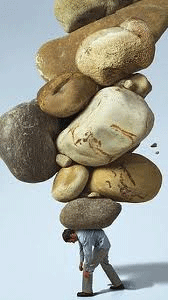
Weighed DownWe talk about stress as if it’s something “out there,” that hits us against our will. Science tells us, quite to the contrary, that it’s our reaction, a particular way we respond to certain people or events.

These people and events are things we judge negatively, so the step that leads to stress is judgment. That too isn’t objectively “out there.” A person you judge to be stressful, for example, may well be a source of comfort to his or her family.

Judgment is part of our natural defense systems. Our ancient ancestors scanned the savannahs on the lookout for danger, ready to trigger the stress response and the exceptional power of fight or flight.

Today, judgment in the safety of our secure lifestyles is often overused. We make judgments — now called “opinions” — about all sorts of things that aren’t the least bit threatening, and about things of which we know little. We judge certain politicians or celebrities to be good or bad without really knowing them or their true motivations. These are snap judgments.

The collection of snap judgments grows over the years. In our discussions with others of similar or different opinions, we form the alliances and animosities that characterize us. It becomes difficult to change opinion without good reason, else we confuse ourselves and others. Holding to these opinions becomes a matter of integrity and self-identification. It becomes who we are.

It makes no difference whether those opinions are good or bad, right or wrong, trivial or monumental, necessary or not; holding on to each one of them is holding on to a bit of stress. The point of the reflective lifestyle — what Socrates suggested to “know yourself” — is to see these opinions for what they are, with the practice of Mindful Reflection™.

What you see is invariably a good deal of baggage and dead weight. Those opinions are not who you are; just something you hold on to. This realization prompts you to want to let go, but that’s not so easy. It emerges that all that baggage is now an integral part of your stress response system. A family member has to say just the right word, or raise just an eyebrow to set in motion a chain of events that lands you with your foot in your mouth before you’ve even noticed your judgment and reaction.

Getting to the root of stress, then, is not just an intellectual exercise. Nor is it just a matter of honest reflection, although that’s certainly where it begins. You must go deeper to uproot the habits of a lifetime. Letting go is a matter of practice, trial and error, and patience. It all begins with turning your attention inwards and watching your mind at work. Once you’ve identified your own personal patterns of stress, then you can start building counter habits and dismantling costly stress patterns.

The alternative? Letting these stress patterns grow ever more deeply ingrained, leading to less and less self-restraint and a cranky old-age.

Living Up to the Hype

The things that are expected of us — and that we expect of ourselves — sometimes lead to the very behavior we’re trying to avoid. Politicians are supposed to live up to higher ethical standards than the rest of us, but how? Do they have special training? Exceptional force of will? Astounding personal power? No; they’re just human — and animal.

We humans love our cleverness and sophistication, but the amygdala still underlies our nervous response. The amygdala’s the deep-brain hub of impulsive reactions; it conditions experience way before rational decision-making has its say. The four Fs — food, fight, flight and fornication — are still right up there as human motivators. Public heroes are routinely undermined by this: Tiger Woods, Arnold Schwartzenegger, Dominique Strauss-Khan, Greg Mortenson — with a google or two, this little list soon turns into a bulging database.

“Really, if you never get angry or lustful you need to see a doctor; it’s not natural.”

We half expect this of the rich and famous, but teachers command more trust — particularly spiritual teachers. Failures on their part are stellar, on a par with our expectations of them. That’s in part because they do have training, or at least they should have. Popular definitions of religion or spirituality mention a higher power and a belief structure, but the real meat and potatoes of any spiritual path lies in knowing and working with your own mind. I use a collaborative term — ‘work with’ — rather than ‘control’ because total self-control is an illusion. More to the point, it’s a vanity.

In particular, it’s a vanity too often indulged in by spiritual teachers. It has to do with ego, but the greater motivator is fear — fear of being exposed as merely human. Those who address congregations, meditation groups and yoga classes are urging people on to higher levels of awareness and behavior. Understandably, they feel the need to exemplify it. A diploma, a title and a well-spun bio aren’t enough. Spiritual teachers must model credibility in their physical and mental demeanor.

For some, that means smiling constantly, saying only good things about everybody and accepting every point of view in the name of open-mindedness. They exhibit no anger, jealousy, covetousness or petty-mindedness — or at least, they try not to. Most tragically, they abandon the critical tool of discernment.

To deny your amygdala is to mess with your head in the worst possible way. Really, if you never get angry or lustful you need to see a doctor; it’s not natural. To deny these impulses in the name of a spiritual practice is, to coin a biblical phrase, an abomination. Emotions are a fact of life; you might even say they’re the fact of life. When somebody wrongs you, you get angry not because you should, or because you decide to; you just get angry. The question is, how do you deal with that emotion? Handled honestly, it’s a source of creativity, insight and integrity. However, that doesn’t happen without effort; it takes a true-to-life commitment of mindfulness and reflection.

Those with a weak or inauthentic spiritual practice bottle up inconvenient emotions until they explode in all the wrong ways. Often, they do it in the very name of spiritual practice — smiling benignly, dropping spiritual buzz words and hoping against hope that they’ll magically become better people. That’s when the explosion is both spectacular to everyone else and utterly mysterious to themselves.

To be alive is to be under pressure. There are no excuses for not dealing with it, and there’s no way to escape the natural laws of  cause and effect. Untrained minds don’t find peace. Pretending to be in control brings disaster. These may be old, old truths, but the fact is we’re still learning them. Let’s be honest about it and give up the hype.