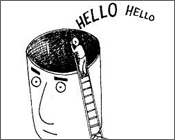
The Open Mind: Not for Everyone

Over the years I’ve taught hundreds of people the basics of mindfulness and Buddhist reflection. Many come back again. I take as a sign that I’m doing my job right, but I also know they’re taking responsibility for themselves. You have to work at opening your mind; it doesn’t happen by itself, and it’s not magic.

Sometimes people express great interest in my workshops, but never show up; others come once but never again. I don’t take it personally. Mindfulness meditation takes some getting used to. Almost as soon as you sit down, you experience the urge to get up and make a snack, talk to a friend or watch TV. The practice is all about being still, watching your impulses rather than giving into them. That stillness eventually turns into a state of intense peace and clarity, but along the way there’s tons of resistance.

If you persist, the resistance becomes more strategic. You begin to value silence, but make exceptions: ‘spiritual’ conversations, speculation about past or future lives, explaining tragedies as part of a cosmic pattern, attributing causality to transcendant forces — these are all distractions from the honest task of insight.

If you really want to open your mind, there’s no room for magical thinking or spiritual speculation. Taking comfort in supernatural forces, amazing prophesies, tales of rebirth, almanacs, astrology, palmistry or tarot may make you think you’re living life differently from the masses, but you’re not; you’re just dressing up the same old escape patterns in fancy clothes.

The Buddha called his path, ‘the end to views.’ It’s a phrase to sit with; it encapsulates everything that mindfulness is about; paying attention to what’s actually happening here and now. The object is to be fully present to your life, not just to smell the roses, but to watch them decay as well. Mindfulness is not just a way to feel good, but to feel everything. Nor is it an end in itself. Without speculation, distraction, excuses and avoidance, you begin see your mind at work in real time. You become acquainted with your own motivations in ways that can be shocking. You may find you don’t know yourself all that well, and probably never will. That’s not a bad thing; the fact is, you’re changing and growing up as continuously as you did as a child.

We tend to embed ourselves in familiar patterns; they seem secure. We do the same things, react the same way and lean on habit. However, any safety you find in that sort of evasion is illusory; it limits your potential and restrains your perceptions. By not sticking your neck out, you miss what’s going on. The survival mechanism is an automatic response to life that turns instinctively to avoidance and denial. It can be a life-saver that enables you to function under short-term duress, but in the long term it ignores the great potential of human life.

Mindfulness pushes against the narrow confines of automaticity by clearing away speculation and habit, by bringing your attention to bear on the present moment and by revealing it to be constantly changing. It’s always unpredictable; it’s often astonishing.

However, it seems easier to dwell in thought than to be exposed to experience. Thoughts have their own momentum; they’re fluid and rarely hold you to account; they pull you away from what’s happening right now before your very eyes; they lull you with narratives from the past. Mindfulness, on the other hand, demands your full attention and hones your mental faculties. It teaches you that you haven’t finished becoming you; that life still holds surprises. Mindfulness makes you adaptable and intelligent in ways you’d forgotten. You see into your hidden recesses; you rediscover your resilience, adaptability and the greatest human strength of all: to reach out with uncontrived friendship.

Mindfulness is not a religion, a philosophy or a belief system. It’s a practice, based on the most fundamental act of consciousness: attention. Still, it’s not for everyone; you have to really want to explore yourself … as if you were a stranger, full of promise and wonder, with gifts for the world.

========================================================================
Stephen will speak at Hudson’s Awakening Festival, June 18th: www.awakeningfestival.org.
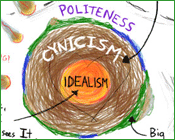
The Politics of Cynicism

Canada’s just kicked off a federal election campaign. Once upon a time this would have been purely regional news, but I’m seeing something that’s mirrored in the US and Europe too — deepening cynicism among voters, politicians profitably disconnecting from reality and democratic values turning into shells of cliché and empty rhetoric.

None of this is new, and that in itself makes me think. In recent days I’ve watched a video of a twelve year old girl telling off the United Nations Conference on Environment and Development, an eloquent, new yet classic anti-war rant, a beautifully produced (another) manifesto against blind conformity and an old, old recollection of Jimi Hendrix’s If 6 Was 9, which promotes individuality against both culture and counter-culture.

It all resonates for me. It always did. The twelve year old girl’s speech was so timely I assumed it was yesterday; in fact it was delivered two decades ago. Old rants against the phoenix of old wrongs, both perennially renewed. The outrage of my sixties generation was unprecedented. We were uncompromising. We weren’t pretty. We were communists and anarchists. Some took up arms. We were sure to turn the tide of corporatism, money and war. Instead, we were slowly recruited into the fold. Today, power-brokers spin the concepts of freedom and democracy while racking up obscene profits at the cost of our planet, our health, our sanity and our social cohesion; some of them are my old comrades.

The English philosopher John Gray said, “…intolerance for reality is innate in the human mind.” In Canada, our prime minister has spun the concept of political coalitions — a venerable, practical feature of parliamentary democracy — into a spectre of lingering evil. His opponents have fallen hook, line and sinker for this misrepresentation and spent time, money and credibility defending themselves against it and accusing him of doing the same thing, as if it were a problem — or even an issue. It’s a non-debate — a diversion that treats voters with unprecedented contempt. Perhaps we deserve it.

The intellectual and emotional level of political debate seems to have reached an all time low. Instead of exchanging views and perspectives, political foes today cast aspersions on one another’s intelligence and integrity. This ignorant disrespect is reflected and magnified in hundreds of thousands of comments on political blogs — disheartening forums of insult and abuse that split the political spectrum into your side and mine. Fix your allegiance and slag the other. It requires no thought, no study, no effort, and apparently delivers enormous, obnoxious self-satisfaction. Here are our neighbours, parents of the next generation, power-brokers of the future. Many are university-educated in specializations so narrow that they’re actually profoundly ignorant of the context in which they spout their ‘opinions.’ Is the educated class a thing of the past?

It all makes me wonder whether our forefathers were right to give a vote indiscriminately to every man and woman. Shouldn’t that right be a privilege, conditional on actually contemplating the issues, or at least acknowledging that other points of view might have merit? How can anyone be so sure of themselves?

Which brings me to my field — the contemplation of human motives. I recognize blunt certainty: it’s a cover-up of existential unease, of the instinctive knowledge that nothing is sure. How few people — even fewer public figures — acknowledge that life is a mystery for which we have many theories but no answers. The healthiest among us take their knowledge with a grain of salt and keep their minds open. Those who cling to certainty with violent conviction are driven by forces that may originate within them, but from which they’re profoundly out of touch. John Gray continues, “The pretence of reason is part of the human comedy.”

We need a thoughtful society. It’s asking a lot — so much that you’re probably already shaking your head, incredulous at my naïveté; but how can we ask for less? What about the omnipotent, omniscient, fictional ‘they’ to whom we always pass the buck? Will they do something about it? Shall we continue the long wait for human institutions to act humanely? ‘They’ will continue to pursue their own interests by clumping into power structures too big for any of us to bring down, short of violent revolution. Real solutions will not trickle down from the top; they can only swell from the bottom up — from us. Be mindful, think reflectively, learn empathy. Teach your children, with words at least but more importantly by example.

Our society has become a frenzy of acquisition that may well implode. We have more stuff than our forefathers, more than we need; far too much to make us happy. Managing it is so onerous that we find ourselves under stresses that are poisoning society and killing us — and ours is the fortunate, developed, ‘advanced’ society. More stuff stimulates more need, more greed, less introspection. Maybe one day the battle lines will be drawn and we’ll bring it all down by force. But then, just like our prime minister’s foes, we’ll have fallen for their spin and will just rebuild in the image and likeness of those same old aggressive passions. Study history: it’s happened before with numbing regularity.

It’s hard to keep hope, and yet — fortunately — we’re programmed to keep hoping. It’s irrational, probably impossible, but I can’t help it: I want a sensible world. What little we can do is dictated by circumstance, not by whim and certainly not by belief. Will we cultivate sensitivity to circumstance, to the messages from the biosphere and from those within it? It’s the incontrovertible message of the stewards of the Earth — the aboriginal cultures — but will we ever again find such clear simplicity?

Feel helpless and outmatched if you must, but don’t leave it to ‘them.’ Go inwards; seek insight. By simply pursuing personal balance we model it to others, and remind each other to be respectful, clear-headed, thoughtful and forceful in expressing what we believe while acknowledging that that doesn’t make everyone else wrong. Whatever else we might do, it has to begin with this. Take little steps and long strides may follow. Take no steps and you foster the growth of cynicism.

Doom & Gloom

What an extraordinary time we’re going through. Some people are saying that the earthquake and tsunami in Japan are just the tip of the iceberg, and that March 11, 2011 began a new era — the Revolution of Consciousness. Expect more catastrophes as Isaiah, Nostradamus, Cayce and other great seers are fully vindicated — but also great and good things as the world is purged and the human race is forced to step up to a higher level of consciousness.

Last year too was a bad one. Natural catastrophes cost insurers more than ever before — a whopping 37 billion dollars, never mind the human toll: 230 thousand dead in Haiti; two years before that seventy thousand in Sichuan; eighty thousand in Kashmir in 2005 and another 230 thousand in 2004 from the tsunami off Sumatra. Then there were hurricanes, volcanic eruptions, landslides, pandemics and famines. Mother Nature is awesome indeed — not always as nurturing as we like to think.

And then there’s us. We’re even more powerful than nature — tah-dah! —  waging war without cease and counting our dead by the millions. Yes, there’s always a war going on, though not always on that scale. As you read this, nine major conflicts are costing at least one thousand deaths per year, never mind the heartache, dashed dreams and maimed lives.

What have we learned from all this? That war is hell. That humans are stupid. That rebuilding is lucrative, and there’s profit to be made if you play your cards right.

Really, what have we learned? We know that life has its ups and downs; that things come and go, that life is finite. There are always those who hate war, just as there are always those who perpetuate it; always those who try to avert natural disasters by appeasing their gods.

Look back in history as far as the archeological record and the printed word allow, and you’ll find nothing strikingly different in any era. Technology has evolved it’s true; it’s made our life so complicated that we have less time to notice that plus ça change, plus c’est la même chose. But in the world of ethics and human behavior, I struggle to see some significant differences, some evidence that we are progressing. Most curiously, when I look inside myself I see that I really hope to find evidence of progress, of providence or a helping hand. It’s not objective wish — it’s a visceral longing — the sort of impulse that makes us see what we want to see, as if it would make a difference.

Whether predictions are borne out by reality or not, there’s absolutely no way to satisfactorily prove or disprove the claim that some people possess uncanny powers. Nevertheless, for believers and detractors alike, it’s a source of enormous passion. Why does it matter?

I just finished reading A Short History of Everything, in which author Bill Bryson rather impressively fulfills the title’s promise by accounting for the evolution of the universe and everything in it, including us and our knowledge. Taken at this level, science describes miracles as plentifully and as inexplicably as any shaman, soothsayer or prophet. The various conditions needed for life are so complicated, and depend on such unimaginably coincidental timing, that our very existence seems astronomically improbable. In cosmic terms, the relative peacefulness of the human race’s few thousand years is hard to believe — a tall story if ever there was one given that our universe, solar system and world were formed by nothing more or less than continuous cosmic cataclysm.  The earthquakes and unnatural disasters described above really — really — don’t come close. Compared to the meteor impacts, ice-ages, tectonic shifts and miles-wide volcanic calderas of not all that long ago, recent history is a model of peace and prosperity. Sorry to use the word again, but it’s a miracle we haven’t been wiped out yet.

So what? Why does it matter? Well, we all have our own belief systems to answer this. Mine is Buddhism — sort of. I have my own take on what the Buddha was on about, but it clearly was quite different from conventional religion. He advocates fewer beliefs — I’d say none at all, if at all possible. He counts on quiet observation of what we can know for ourselves from our own experience; he treats theory and explanation with a healthy dose of skepticism. Who put us here? Why? These question are already loaded with presumptions plucked from thin air. I love the Buddha because he specialized in reducing facts and questions to their simplest possible form. Here we are. What now?

His answer? Live with attention, insight, compassion and acceptance. What else? Will we get better? If we try. What helps? Understanding ourselves — no, not theorizing — understanding. You can spend your life trying to prove the existence or non-existence of gods, providence or progress. Think you’ll find conclusive answers that everyone will finally agree on? Think again. Even if you were to succeed, what would you do with the terrible weight of all that knowledge?

Life doesn’t need proof, prediction or explanation. As homo sapiens, we use ideas to survive and prosper; fine. Beyond that, playing with ideas and theories can be fun. But in the big picture, we really need to take them all with a grain of salt — not just religion, not just new consciousness, but science, technology and academic research too. Life’s too short.

If we really want to make the world a better place, we need to shed opinions, prejudices and the presumptuous need to do or say something even though we don’t actually have a solution. For that, there is no more  powerful tool than mindfulness. It’s not an idea; it’s a practice.

==============================================================
New workshop starts Tuesday, March 22nd: Dealing with Anxiety & Fear. Sign up here.

The Office

If, in fifteenth century Europe, you were asked to attend The Office, you might well tremble in your boots — even lose control of your bowels — for you’d have been summoned to the Tribunal of the Holy Office of the (Spanish) Inquisition. Today, Quebec businesses are also called to account by The Office. Although it’s not the Spanish Inquisition — it’s the Office québécois de la langue française — it provokes fear, loathing and sometimes mild paranoia among Anglophones.

Last month I received such a summons myself. My Quiet Mind website, which advertises and supports weekly mindful reflection workshops, is in English only. Someone was offended enough by this to contact The Office and complain about me formally. I wasn’t happy about the potential inconvenience and cost of translation, but I didn’t lose a night’s sleep over it — let alone my bowels. Nevertheless, friends, relatives and students gasped in shock. They seemed to anticipate the sort of McCarthyesque injustice that periodically makes headlines in Canada. One imagines tenured bureaucrats with power aplenty, chips on their shoulders and way too much time on their hands.

This is the uniquely Canadian melodrama I was faced with when I landed here in 1982. I’d been studying at the École de français moderne in Lausanne and chose Montreal because it was French-speaking and would enable me to polish my nascent French skills. Despite immigration officials’ assurances that Montreal was sublimely Francophone, however, I found the city so bilingual that most people switched to English as soon as they detected my accent. Opportunities for practice were few and far between.

I was also confronted with the ‘two solitudes’ — willful non-communication, sometimes miscommunication, between French and English-speaking politicians, as if this somehow reflected reality on the streets. The recently elected Parti Québécois government wanted passionately to declare independence from Canada; its supporters were devastated by the defeat of their referendum. Anglophones breathed a sigh of relief but still lay awake at night worrying. The oft-repeated phrase about the county being ‘split apart’ projected an image of continental plates torn asunder. Indépendentists bided their time, rubbing their hands in glee as each big company fled Quebec. The insistence of the Office that business be carried on in French increased costs — from a business point of view, often pointlessly. Small mom and pop businesses closed shop and the commercial face of Montreal changed.

In the press and on television it sounded like war, but I found the Quebecois easy-going, decent and helpful — as most people are in relatively free countries. Admittedly, I was baffled by the notion of ‘protecting’ a language. After all, it can only mean what everyone agrees it to mean, otherwise it’s not much use, is it? Languages change and morph constantly; they have an organic life of their own. How can you legislate them? You might as well try to amend the laws of thermodynamics. I knew this from my own studies of Tibetan and Sanskrit, and even by comparing the language I learned in England with English spoken elsewhere. Each environment lends its own shape and inflections. My favourite version is Indian English — a transplanted, lovingly nurtured and enriched form of Queen Victoria’s vernacular. If I say so myself, I speak it well.

Anyway, this week I had to explain to the Office why I hadn’t conformed to article 52 of the French Language Charter, which states: “Les catalogues, les brochures, les dépliants, les annuaires commerciaux et toute autre publication de même nature doivent être rédigés en français.” (‘All other publications’ apparently includes websites.) I teach in English, and much as I’d like to in French, can’t do so with the same fluency. My French simply doesn’t penetrate the subtleties of idiom and story-telling, both of which I lean on heavily in my classes.

The conversation was brief. I explained that Quiet Mind was not a commercial enterprise, and that the revenue just covers expenses. In my best formal French I added that I have two commercial websites, both bilingual. Formal French is easier than vernacular. I’ve never managed a good, heated argument in French, but if I stick to technical subjects — I have good vocabularies for computers, grammar and the law — I can impress professionals and, apparently, bureaucrats. The lady I spoke to at The Office was charming. She complemented me on my French and assured me that as long as I taught only in English, a French website would be unnecessary. Finally she added that, if ever I chose to teach in French, I’d need to advertise in French too.

Everything had gone well until that moment. The implication was that, without the Charte de la langue française, it would never occur to me to advertise French courses for French-speaking people in French. She seemed to assume that, being an Anglophone, I’d naturally attempt to do so in English. I almost asked if she thought I was a complete idiot, but kept my mouth shut.

The question of indépendence and the primacy of the French language still dominate Quebec. After almost thirty years here, I still see little rationale for either sovereignty or federalism — only emotional partisanship. Anglophones can’t believe my impassivity towards the issue, not realizing to what extent the ‘two solitudes’ mindset has preoccupied their thinking. I see this as more of an ideological debate than a political one. But what do I know? I’m just a poor immigrant. I steer clear of the authorities when I can; when I can’t, I pull down the brim of my hat and maintain my ignorance.

The Customer’s Always Right

My dad ran a fine Gloucester restaurant in the West of England and used to recite these words like a mantra. It contrasted with his considered opinion that many customers were philistines who didn’t appreciate good food and wine. Still, he acknowledged their custom nevertheless, knowing that his livelihood depended on them. That wasn’t the least bit unusual; it was the prevailing business attitude in those days before the term ‘customer service’ was invented.

Today, it’s a ubiquitous label used by corporation worldwide, ostensibly to establish in black and white that yes they really do care about their customers, but more often to deal with disgruntled ones. Getting through to someone with authority in the higher echelons of today’s corporations is about as easy as getting through to Barack Obama for a nice chat.

A case in point is Videotron, my cable internet supplier and, oh dear, a service industry. I called because I had been initially charged  $5 for 5 gigabytes of bandwidth, but then $7.95 per additional gigabyte. Why, I wanted to know, were there two rates?

“Because,” said the customer service representative, you went over what you were allowed.

“Allowed?” I echoed. “You make me sound like a naughty boy. Don’t you want me to consume your product?”

“Of course we do, sir.”

‘Sir,’ of course, is meant to denote respect, but you’d never know it from her tone of voice.

“Well,” I said, “It seems punitive to me. Why would you want to upset your customers?”

“We’re not trying to upset our customers,” she insisted.

“Well in this case you have. Don’t you find that unbearable?”

No answer.

“So why are there two rates?”

“I already told you sir, because you went over your limit. You’re not allowed to do that.”

“Allowed,” I mused. “There’s that word again.”

She ignored me.

“Please remind me, why am I not allowed?”

“Because you’ve purchased a 5 gigabyte package and have gone over the limit.”

“So I used more, and I have to pay for it.”

“Exactly,” she said, relieved that I’d finally seen the light.

“Fair enough,” I added.

“I’m glad you see my point, sir.”

“Good,” I added. “Now, why does the cost go up by 795%?”

“What?”

Well, $5 for 5 gigabytes is a dollar a gigabyte, correct?

She didn’t answer.

“And $7.95 a gigabyte is 7.95 times as much, right? That’s a 795% increase.”

She’s still silent.

“Look,” I said, “If I’m not allowed any more, why don’t you just turn off the tap?”

“What?” Now she’s annoyed.

“Why don’t you stop supplying me when I reach my limit. After all, I’m not allowed any more — right?”

“We don’t cut off our customers like that sir.”

“Ah,” I said. “Could it be that you want me to go over, so you can the gouge me?”

Silence.

“Is that it? Does Videotron engage in trickery?”

“Sir, why did you contact us?” Her voice suggests I’ll be nonplussed by her clever question.

“To get my money back,” I said. I’ll give you two dollars for two gigabytes. Seems fair to me.

“And what happens next month?”

“Next month?”

“Yes, sir. You’re going to go over the limi again next month. Then what?”

“I’m confused,” I said. “You know how much bandwidth I’ll use next month?”

“You went over your limit this month. You’ll go over again next month, and the month after. Then what will you do?”

“Good Lord,” I exclaimed. “You see into the future? How can you possibly know what I’m going to do in the next month?”

“How much bandwidth will you use then, sir?”

I’m now irritated. “I don’t know. If I did, it would be none of your business.”

“You see?” she says, “You don’t know. That why you need to purchase our Extreme high-speed package.”

“Don’t want it,” I said. “Are you going to refund that extortionate billing, or do I move to one of your competitors?”

“Our competitors bill their clients exactly as we do, sir.”

“So?”

“So that’s what we do. It’s perfectly reasonable.”

“Because they gouge their customers, it’s okay for you to do the same?”

“Yes.”

She missed that one. The poor girl wouldn’t know a logical inference if it hit her in the face. Perhaps that’s because she’s sacrificed her wits for her job, trying to follow bureaucratically-designed customer service conversations instead of her own sense of right and wrong. She sacrifices her integrity daily to keep her job. Sad.

“So will you upgrade to the extreme high-speed package?”

“No thanks. I don’t need it.”

“Yes you do sir.”

“Who on Earth are you,” I explode. “God?

“So why are you calling us?”

“Actually, I’m not calling you. I emailed you and expected an email response.”

“We called you back, sir. That is Videotron’s policy. We wish to speak directly to customers in order to resolve their concerns. It’s in the customer’s best interests.”

“Not mine.”

“Why is that, sir?” Oh boy, she ready for me now. I bet she has company policy memorized word for word.”

“Because you didn’t leave me a call-back number.”

“It’s not our policy to do that, sir.”

“I suppose that wouldn’t be in my best interests?”

No answer.

“And you called, what, ten or twelve times, disturbing my wife and daughter with your incessant calls, leaving no message.”

“Sir, it’s not Videotron policy….”

“So what’s your answer? Do I get my refund, or find a new internet supplier?”

“You won’t get a penny more.”

“A penny more than what?”

“Than the $15.90 for the two gigabytes at $7.95.”

“You’re actually going to refund it?”

“I’ll give you a credit, sir. But you won’t get a penny more in credit.”

“Madam,” I explain, “You’re giving me exactly what I want.”

“That’s all!” she insists. “Not a penny more!”

I exclaim, “Oh dear!” Perhaps that will console her.

“Is there anything else I can help you with this evening?”

“No thanks.

“Thank you for contact Videotron Customer Support sir, and have a great day.”

“Really?”

I hang up thinking about the Buddha’s injunction to avoid wrong livelihoods. It couldn’t be simpler. Put your source of income before your own integrity and you’re on a slippery slope to discontent and stress. Sure you need money, but you need mental health too, something too often pushed far down the list of priorities. When you think that Xeroxed conversations like this are being taught to tens of thousands of people in customer service centres worldwide, you can only wonder what the world’s coming to. But then, people wonder that in one generation after another, don’t they?

What a strange lot we are, human beings.